How to Study with Spaced Repetition: The Complete Guide for University Students
You know that awful feeling when you study incredibly hard for an exam, only to realize that 10 days later, you barely remember a thing?
It happened to me far too many times during my freshman and sophomore years. I would pull all-nighters rereading my notes, feeling totally prepared… and then freeze up or struggle on exam day.
The problem wasn’t my memory. It was my method.
Ever since I started using Spaced Repetition consistently, my grades have skyrocketed, and more importantly, I spend significantly less time studying to get better results. That is exactly why I made sure to deeply integrate it into the core of EIDO.
What is Spaced Repetition?
Spaced repetition is a study technique backed by the cognitive science of memory. It leverages the forgetting curve, discovered by psychologist Hermann Ebbinghaus in 1885: we naturally discard the vast majority of new information very quickly unless we actively review it.
The genius of this method is simple: review information right when your brain is on the verge of forgetting it. By doing this, your brain flags the information as crucial and consolidates it into your long-term memory.
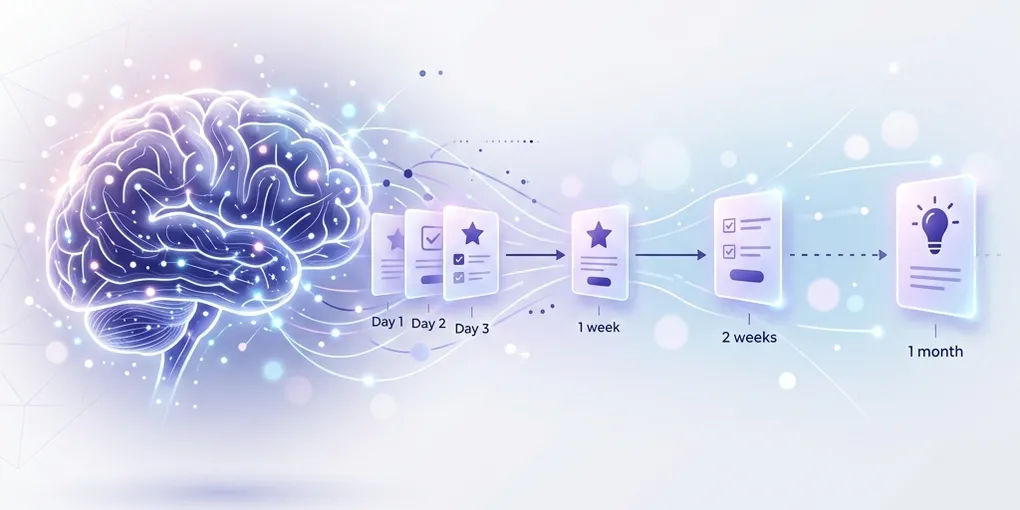
A typical optimized review schedule looks like this:
- 1st review → after 1 day
- 2nd review → after 3-4 days
- 3rd review → after 7 days
- 4th review → after 2-3 weeks
- 5th review → after 1-2 months
After a few properly timed reviews, that concept is permanently locked in your brain.
Why it easily beats “just rereading your notes”
Passive rereading only builds the illusion of competence. The text looks familiar as your eyes glide over it, but when you actually have to pull that information out of thin air during an exam… it’s gone.
Spaced repetition wins hands down for three main reasons:
- The Spacing Effect – The brain consolidates memories far more effectively when reviews are spaced out over time, rather than crammed into one session.
- Active Recall – You are forced to actively retrieve information from your brain instead of just scanning it. Scientific studies consistently rank active recall as one of the single most powerful learning techniques.
- Maximum Efficiency – You don’t waste precious time reviewing concepts you already know inside out. The algorithm dynamically schedules cards so you only focus on what you’re struggling to remember.
How to apply it practically (step-by-step)
1. Frame everything as a question
Never write flat statements. Create active questions:
- ❌ “Mitosis has 4 stages: prophase, metaphase…”
- ✅ “What are the 4 stages of mitosis, and what key event happens in each?“
2. Create flashcards (or let EIDO do the heavy lifting)
Perform your first review session either the same day or the very next morning.
3. Stick to the intervals
You can keep track of intervals manually, or let a dedicated tool handle all the scheduling math for you.
Pro Tip from a daily user: The best flashcards are atomic (one concept per card), highly specific, and ideally include images or diagrams. The brain retains visual cues infinitely better than plain text.
What exams does it work best for?
Spaced repetition is an absolute game-changer for:
- Medicine & Biology (Anatomy, Pharmacology, Pathology…)
- Law (articles, codes, legal procedures)
- Languages (vocabulary, grammar rules)
- Business, Chemistry, Physics, Engineering…
Essentially, any subject that demands a large volume of memorization. With well-crafted questions, it works beautifully for highly conceptual subjects too.
FAQ – Frequently Asked Questions
How much time should I spend on this daily?
Usually, just 15 to 25 minutes a day is all it takes. Consistency matters infinitely more than the length of the session.
Does it work for oral exams?
Yes, absolutely. It trains you to retrieve concepts instantly and express them in your own words, which is exactly what oral examiners look for.
Can I use it at the last minute?
It’s better than nothing, but you’ll get the absolute best results if you start using it at least 2-3 weeks before your exam date.
Which is better, Anki or EIDO?
Anki is an excellent tool. However, I built EIDO because I wanted something much faster and frictionless: you simply upload your PDF and get instant, professionally structured spaced repetition cards without having to configure complex settings manually.
Start Today
Spaced repetition isn’t just another passing study fad. It is one of the very few learning methods that is backed by over a century of robust scientific research.
I designed EIDO specifically to eliminate all the tedious administrative work—like creating the cards manually and calculating review dates—so you can focus entirely on learning. If you’re curious, you can try it completely free today.
*Leonardo, Founder of EIDO* *May 18, 2026*