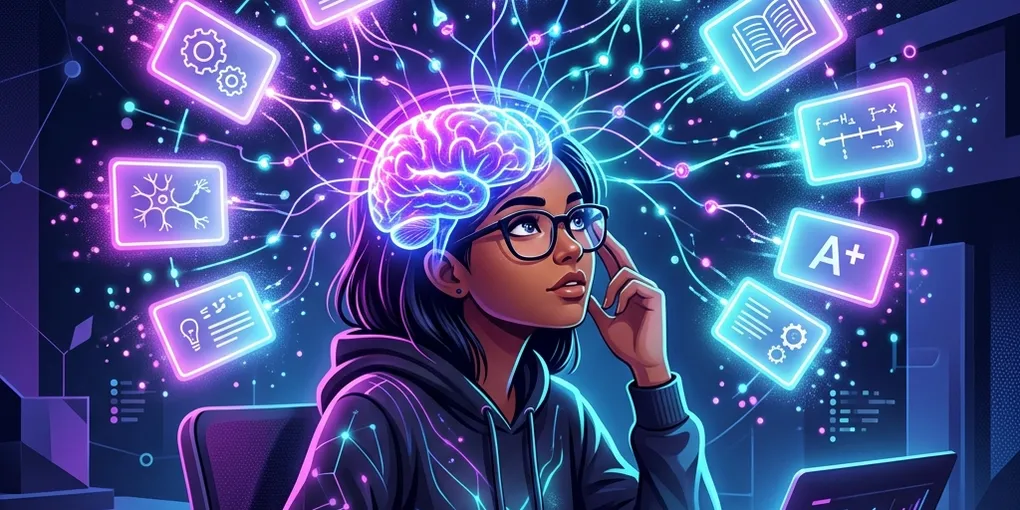
Active Recall: Why Studying by Rereading is Almost Useless
It’s a feeling I know all too well.
You’ve just spent an hour rereading 30 pages of lecture notes, highlighted almost every line, and you close the notebook fully convinced that you know the material inside out.
Then, five minutes later, someone asks you: “So, what exactly is the depolarization of a cell membrane?”
And your mind goes completely blank. Total silence.
You aren’t the problem. Your method is.
Passive rereading builds a dangerous illusion: because the text feels familiar as you scan it, your brain mistakes that familiarity for actual comprehension. But recognizing a concept when it’s right in front of you is entirely different from being able to recall it from memory. On exam day, nobody is going to show you the highlighted text to jog your memory.
I learned this the hard way: by scraping a disappointing 18 on a final exam that I had spent six full, grueling days studying for. That failure forced me to dive deep into the cognitive science of memory, and I completely overhauled my approach. Today, I can prepare that exact same amount of material in just three days, and actually retain it for months.
The secret is a technique called Active Recall.
What is Active Recall?
Active recall (or active retrieval) means forcing your brain to retrieve information from memory without having the source material in front of you, instead of simply reading it again.
It sounds like a tiny difference. It isn’t.
Every time you actively retrieve information, your brain physically strengthens the neural pathways leading to that memory. Think of your brain like a grassy field: the more times you walk a specific path, the clearer and more permanent the trail becomes. Passive reading is like looking at the field from a window: you can see it, but you aren’t actually carving out a path.
A landmark study from 2008 by psychologists Roediger and Karpicke proved this beyond a doubt. Two groups of students studied the exact same text. The first group reread the text multiple times. The second group read it just once and then repeatedly quizzed themselves on it. When tested a week later, the active testing group recalled 50% more information than the rereading group.
Why It Actually Works (The Science)
There are three main scientific pillars behind its success:
1. The Testing Effect
The cognitive act of testing yourself (even when you get the answer wrong) consolidates memory far better than passive review. Making mistakes is not a sign of failure; it is actually one of the key moments where your brain rewires and locks in information.
2. Desirable Difficulty
Cognitive techniques that feel more challenging in the short term yield far better retention in the long term. Rereading is comfortable and easy, which is why it feels good. Testing yourself is uncomfortable and demanding. That very discomfort is the physiological signal that you are actually learning.
3. Real Metacognition
When you just reread, you have no real way of knowing what you actually understand and what you don’t. When you quiz yourself, your weak spots are instantly exposed. This allows you to stop wasting time on what you already know and focus your energy precisely where it’s needed most.
How to Apply Active Recall Practically
You don’t need a complicated system. Here are the exact strategies I use daily.
1. The Blank Sheet Method
After reading a section of your notes or textbook, close it completely. Take a blank sheet of paper (or open a blank digital document) and write down absolutely everything you can remember, in no particular order. Don’t worry about making it look neat. The goal is to force the retrieval process.
Once you’ve exhausted your memory, open your notes and compare. What you missed is exactly what you need to review.
2. Turn Headings into Questions
Instead of studying chapters with passive titles (e.g., “Chapter 4: The Cell Membrane”), turn them into active questions before you even begin reading:
- ❌ “The Cell Membrane”
- ✅ “How is the cell membrane structured, and what is its primary function?”
Read the text with the sole purpose of answering that specific question. Once you finish, close the book and answer it out loud.
3. High-Quality Flashcards
Flashcards are the ultimate active recall tool, but only if you write them correctly:
- Keep them atomic (one concept per card). If you pack three different concepts into a single card, your brain won’t master any of them.
- Be highly specific. “What is photosynthesis?” is too broad. “What is the chemical formula of photosynthesis, and where does it occur?” is perfect.
- Use your own words. Never copy definitions verbatim from the textbook. Rewrite them in your own natural phrasing. If you can’t explain a concept in simple terms, you don’t truly understand it yet.
Creating thousands of cards manually is incredibly slow. That is why I built automatic flashcard generation directly into EIDO: you just upload your PDF, and our AI instantly drafts structured, atomic Q&A cards designed specifically for active recall.
4. The Feynman Technique
Choose a concept you’re studying. Explain it out loud as if you were teaching it to a ten-year-old child who has zero background in the subject. Strip away all complex jargon and explain the core mechanics simply.
The exact moment you start to stutter, use vague filler words, or feel the urge to sneak a peek at your notes—that is your gap. Go back to that specific section, review it, and try explaining it again.
It is mentally exhausting, but it works like magic.
Active Recall + Spaced Repetition: The Ultimate Power Couple
Active recall on its own is incredibly potent. But when you pair it with spaced repetition, it becomes unstoppable.
The logic is simple: there is no point in constantly quizzing yourself on something you already know perfectly, nor does it make sense to wait until you’ve completely forgotten a concept to review it. A spaced repetition algorithm calculates the exact moment your brain is about to let go of an item, and brings it up for review right then.
Inside EIDO, I built this algorithm directly into our flashcard engine. Each card tracks your performance and adjusts its next appearance accordingly. If you answer a card easily, it disappears for days or weeks. If you struggle, you’ll see it more frequently until it clicks.
Where It Shines the Most
Active recall works across almost all academic disciplines, but it is especially lethal in:
- Terminology-heavy courses (Anatomy, Pharmacology, Law, Chemistry) — here, it absolutely dominates.
- Oral examinations — it trains you to formulate coherent answers under pressure, which is exactly what happens in front of a professor.
- Technical & problem-solving fields (Calculus, Physics, Engineering) — you can use it to explain the logical derivations of formulas out loud.
- Language learning — vocabulary acquisition and grammar applications are mastered infinitely faster through active flashcards than passive reading.
The only place it shouldn’t be used as your sole strategy is in highly abstract or interpretive subjects (like advanced philosophy), where critical analysis and open discussion are more important than structured retrieval.
Common Pitfalls to Avoid
Confusing recognition with recall.
If you look at the front of a flashcard and think “Oh yeah, I know that” without actually forcing your brain to produce the answer before turning it over, you are just rereading in disguise. Hide the answer. Speak or write it down. Then check.
Hoarding study materials instead of using them.
Spending hours creating beautifully color-coded notes, diagrams, and cards, but never actually spending time active-testing yourself with them. The material is merely a tool, not the final goal.
Quizzing yourself only once.
Nailing a quiz once does not mean it’s locked in forever. Active recall requires spaced intervals over time to build permanent long-term memory.
Quitting when you make mistakes.
Errors are a vital part of the cognitive rewiring process. Missing a flashcard and immediately correcting yourself is actually one of the most powerful learning moments your brain can have.
How to Start Today (No Excuses)
Don’t wait until you have the “perfect” setup. Do this right now:
- Take the very last topic you studied.
- Close your books and notes.
- Write down everything you can recall on a blank sheet of paper.
- Open your notes and compare.
- Study only the parts you missed or got wrong.
It takes less than twenty minutes. But at the end of it, you will know exactly where you stand—and the reality might surprise you.
If you want to make this process systematic, with instant custom quizzes generated from your own PDFs, smart spaced repetition cards, and automatic analytics highlighting your weak spots, that is exactly why I built EIDO.
→ Try EIDO for free and generate your first active recall quiz in under a minute.
Leonardo, Founder of EIDO
May 25, 2026